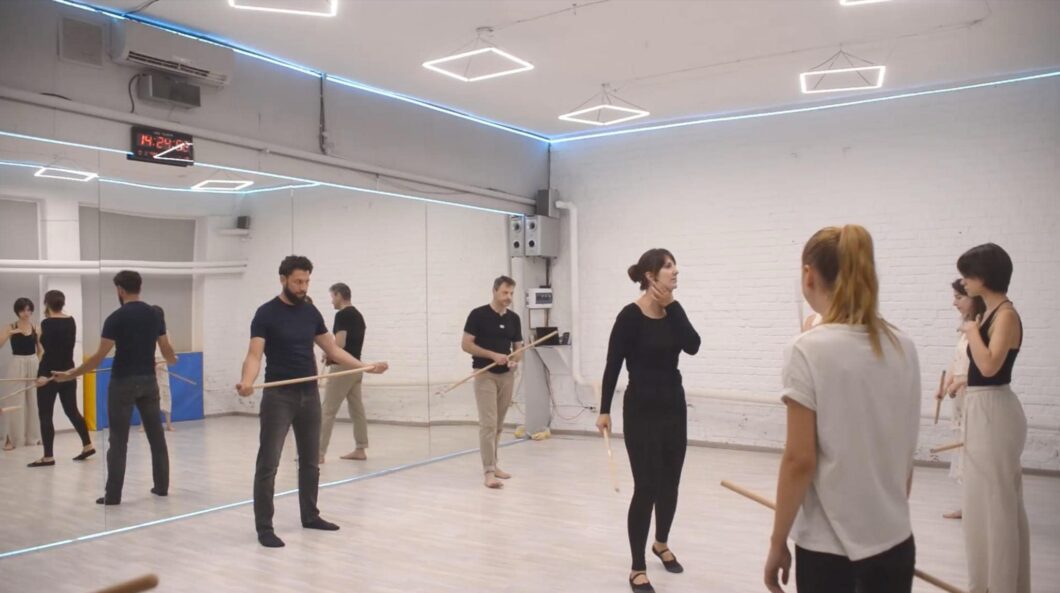
Today I worked with actors—more precisely, with their voices and my own. Despite having a fever and a cold, I had enough energy to enjoy the process. But that’s not what I want to talk about.
As soon as the session ended, I stopped, fell silent, and my voice remained only in my head. I began to ponder and ask my voice to “come out” into the space around me, as wild as that may sound.
Sometimes I recommend to actors to stay silent, listen to the quiet, and then start speaking—any word, a monologue, a poem, anything. This exercise helps to appreciate one’s own voice, which will eventually transform into the voice of a Character. It also helps to track where the sound is born and the journey it takes to reach the audience, partner, or technical equipment.
We often try to “get rid of” the text for many reasons, but now it’s worth considering a different question. If we respect our Characters, our bodies, and our voices, why do we do this? Why do we “throw away” our hero’s words so thoughtlessly and carelessly?
To bring the text to life, I need to engage many elements: imagination, energetic body, physical body, and I must free the voice. We often neglect all this when we “play” the text.
My point, as always, is to take your time, enjoy the game, relish the life of the Character you’ve created, and resonate with every cell of your body. I’m delighted when I can mute the sound in a video and still enjoy the acting, but it works the other way around too. I’m ecstatic when I can close my eyes and “see the movie” in my head through the actor’s voice.
Being a fan of the Stoics, like my dear Eugenia Miropolskaya, I want to end today’s “philosophical” note with the words of Ancient Greek philosopher Zeno, the founder of Stoicism: “The voice is the flower of beauty…” Isn’t that true? Love to all.