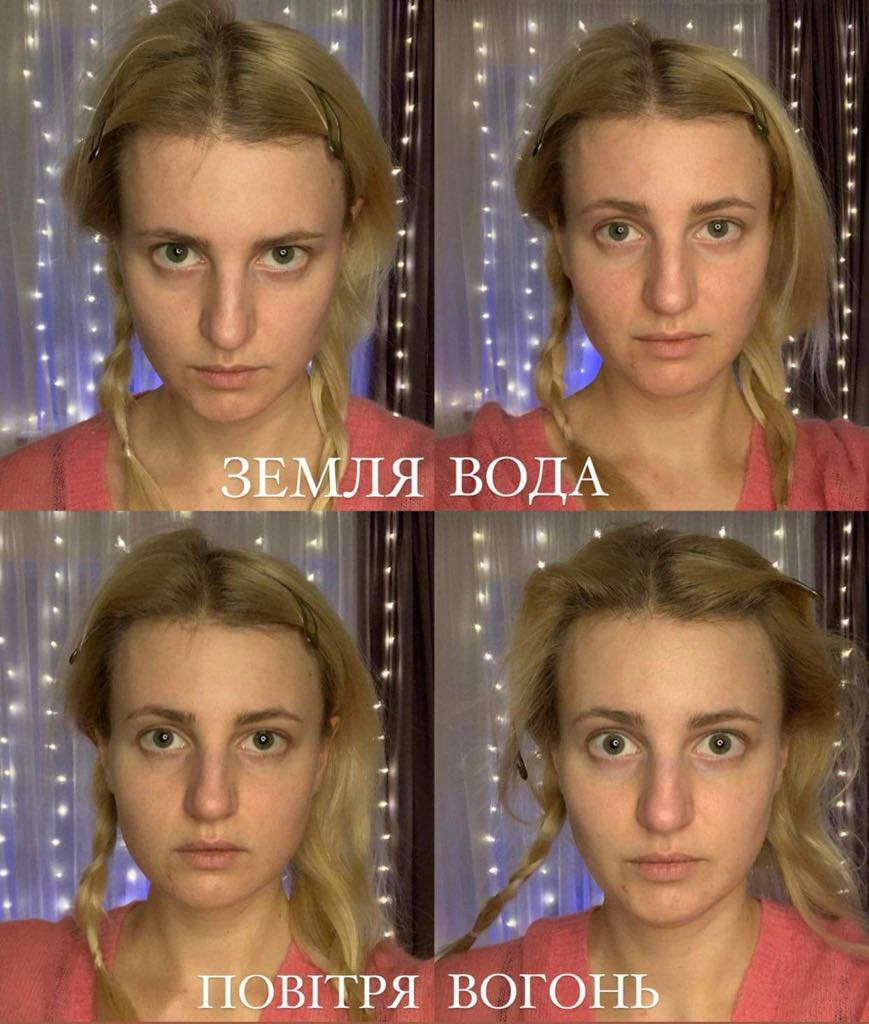
I use them a lot with actors, especially when we work in movies. Cameras 🎥 love this acting tool.
Elements were respected by Plato, Jung, and many other prominent philosophers and psychologists. And now, they have reached the realm of acting.
Plato, in my opinion, gave the best definition of the Elements. They are what complex bodies are made of and what they decompose into. The entire esoteric system suggests that the Elements form the basis of both Humans and the Cosmos, and it would be beneficial if we felt a balance of all four: Earth, Water, Air, and Fire.
A Character is a complex being, just like us, so it’s no surprise that Elements are used to convey the energetic state of the hero. It’s the core, the essence that flows through the veins of your Character.
Michael Chekhov’s understanding of a role by an actor is mostly a process that is not rational but rather sensory and abstract. Imagination combined with the sensation of a specific Element leads to an inner transformation into “something new.” This is precisely what the actor needs—something that will harmoniously fill their body and emit states that are unusual for them.
Why does the camera respond to this? The process of Element transformation occurs deep within us, but the power of this tool is so dynamic that, rising from almost unconscious layers, it gains momentum and penetrates through the camera optics to the ultimate consumer—the viewer.
It’s not easy, but a Character that an actor has “encoded” into an Element will be remembered by the audience for a lifetime, and the actor will be able to “hold” the image for as long as needed. Imagine if a TV series shoot lasts for five years…
This was another snippet from my upcoming book. (c) Alesiaa Fortel (Savchenko) “Actor’s Magic by Michael Chekhov: A Guide to the Actor’s System”
Pictured: the enchanting actress Polina Kalmykova. Thank you, Polina, for the picture with captions 🙂 This photo can be examined under a microscope to see the smallest changes in the face and enjoy the work. The interval between switching states is 1 minute, and the “immersion” naturally took a bit longer, about 7 minutes. More practical details will be in the book 🙂